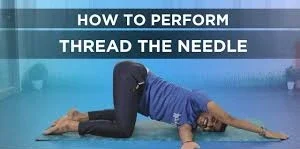
Thread The Needle Exercise
The Thread the Needle Exercise is a gentle stretching and mobility movement that targets the shoulders, upper back, and spine. It helps relieve tension, improve thoracic rotation, and enhance flexibility in the upper body.
You can utilise the Thread the Needle exercise in a variety of stretching and mobility regimens, as it can be performed in both static and dynamic variants.
Table of Contents
What Is Thread The Needle Stretch
Threading the needle is done from a tabletop (hands-and-knees) position using a soft, twisting stretch. By lowering your shoulder and ear towards the floor and sliding one arm underneath your body, you can rotate deeply through the thoracic spine, which is the middle portion of your back that runs from just below your neck to the bottom of your ribs.
This action increases thoracic spine mobility, which contributes to improvements in posture, flexibility, and range of motion.
Muscles Used In Performing the Thread The Needle
- Deltoids
- Latissimus dorsi
- Thoracic spine
- Erector spinae
Deltoids: Your shoulder joints are surrounded and supported by this muscle group, which functions similarly to a cap. You can move your arm in various ways thanks to it. Your deltoids are stretched when you thread the needle, especially the back deltoids.
Latissimus dorsi are the muscles that your shoulder blades rest on, on either side of your upper back.
Thoracic spine: Your spine’s midsection is referred to here. It is located between the lumbar (your lower back) and cervical (near the neck) spines. The mid-back is another name for the thoracic spine. In addition to protecting the spinal cord and internal organs like the heart and lungs, it gives the body structural support.
Erector spinae are the muscles on either side of your spine. They play a part in rotation, stabilisation, and back extension.
Thread the Needle Pose (Parsva Balasana) Video
How To Do the Thread The Needle Exercise?
Although threading the needle is an easy task, it’s crucial to do it correctly to prevent neck or back pain.
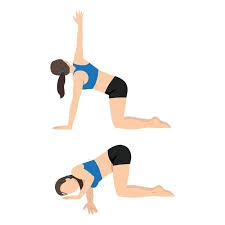
- Beginning on your hands and knees, place yourself on a tabletop. You should position your knees beneath your hips and your hands directly beneath your shoulders or a few inches in front of them.
- With your chest open to the right, take a breath and extend your right hand towards the ceiling. Aim to maintain a square hip position.
- Take a breath out and place your right hand palm up under your left armpit, between your left arm and left leg. Rotate your chest to the left while lowering your right shoulder and the side of your head slowly to the ground.
- Hold this posture while taking deep breaths for 20 to 30 seconds. For additional support, keep your left hand on the floor. Alternatively, to increase the stretch and put more weight on your right shoulder, move it away from your body and onto your fingertips, as demonstrated above.
- Lift your right shoulder off the floor by pushing into your left hand to exit the stretch. To reverse the motion, rotate your chest open to the right while reaching your right hand towards the ceiling. After that, go back to the tabletop position and do the same thing with the opposite side.
Variations in Performing the Thread the Needle
- Grab an Object
- Padding and Support
- Yoga Blocks
- Upward Reach
- Stacked Shoulders
Grab an Object: Stretch your arm out under your body and place anything at your sides that you can reach out and grab. This will assist you in keeping your core under control while you hold the stretch.
Padding and Support: To accomplish the stretch from a more comfortable height, support your shoulder with a pillow or folded towel if you’re having trouble reaching it to the floor. If you experience pain from retaining the tabletop posture, you may also place a cloth beneath your knees.
Yoga Blocks: Yoga blocks could be used to support your weight while threading the needle if you have weak wrists. Start with your forearms on the floor instead of your wrists bearing your weight on your hands if that’s still difficult.
Upward Reach: Continue the motion as before, but when you bring your left arm back through the “needle,” rotate your body so it is facing the ceiling, extending your arm above you as if you were reaching for it. In order to return your arm to the initial position, slowly rotate your spine. Your chest will feel more stretched as a result.
Stacked Shoulders: Use the same technique to reach your arm through the needle, but keep stretching until your shoulders are stacked one over the other. If this posture doesn’t seem comfortable, don’t force yourself to get into it; you’ll feel the thoracic spine extend even more.
Benefits of Performing Thread the Needle
- Beginner Friendly
- Relieve Built-Up Tension
- Enhanced Thoracic Mobility
- Supports Lower Back
- Improved Posture
- Relaxing
Beginner Friendly:
- Since the Thread the Needle stretch is mild, it’s a great choice for beginners, particularly those with a restricted range of motion.
- You simply reach as far as you are able to. in order to give it a shot, even if your initial reach is rather small.
Relieve Built-Up Tension:
- In the parts of our bodies that frequently suffer the most from sedentary lifestyles—the shoulders, upper back, and neck—the Thread the Needle stretch helps to release tension and lessen muscular tightness.
- Anyone who spends a lot of time at a desk can find that their overall mobility is greatly improved by this kind of stretch.
Enhanced Thoracic Mobility: The way the needle twists the spine makes it a good stretch for increasing the mobility of the upper and mid back. It also helps to expand the range of motion in the shoulder by stretching the muscles in the posterior shoulder.
Supports Lower Back: You can relieve the pressure and strain on your back by not moving your hips or lower back and instead using your thoracic spine to rotate. For people who spend a lot of time in a fixed position, this is crucial.
Improved Posture: Strength in this area is essential for proper posture since the thoracic spine, which connects the ribs to the spine, is worked by this stretch.
Relaxing: Particularly, a light stretch can frequently be really soothing, which is one of the reasons Thread the Needle is a well-liked option for yoga.
Common Mistakes to Avoid While Performing Thread The Needle
- One of the most frequent errors made when performing the Thread the Needle stretch is placing excessive weight on your shoulders. Avoid putting too much weight on your shoulders by attempting to maintain your body’s equilibrium.
- You should use your legs to sustain the majority of your weight.
- This should be made easier if you keep your hips steady, your core supported, and your weight on the balls of your feet.
- Lever your body to change the amount of weight your shoulder is bearing by using your stationary arm in a similar manner.
Summary
- All things considered, the Thread the Needle is a really good technique to stretch your shoulders and back.
- Spinal mobility could be greatly improved by doing Thread the Needle for a few minutes on each side for someone who spends a large portion of the day sitting down.
- Not only might restricted movement patterns result from poor mobility in this area, but pain and discomfort can also occur.
- Before beginning any new workout, we always advise consulting a health expert, such as a physical therapist, if you currently experience neck or thoracic spine pain or discomfort. This way, you can get tailored recommendations and advice.
- Limiting your reach to what feels comfortable is also crucial. Excessive stretching may cause harm.
FAQ’s
In addition to improving posture and spinal mobility, the thread the needle position helps relieve stress in the upper back, shoulders, and neck. In addition to providing a mild stretch that can enhance circulation, it also helps people who spend a lot of time in front of a computer by lowering stress and anxiety.
A stretch that mainly works the muscles in your shoulders and upper back is called “thread the needle.” The term stems from the way the motion resembles passing a piece of string sideways through a needle.
A simple twist that improves spinal mobility and can help lessen neck and shoulder blade pain is the Thread-The-Needle pose. It’s basically the position of the Twisted Puppy.
References:
- Bunch, E. (1970, January 1). Melt Away Upper Body Tension with the Thread the Needle Stretch. https://www.onepeloton.com/blog/thread-the-needle-stretch
- Thread the needle. (n.d.). [Video]. Hingehealth. https://en-gb.hingehealth.com/resources/articles/thread-the-needle
- Drum, F. (2023, April 24). Thread the Needle Exercise Stretch – How to Perform, Benefits & Muscles Worked | Fitness Drum. Fitness Drum. https://fitnessdrum.com/thread-the-needle-stretch/