
Bicipital Tendinitis
Bicipital Tendinitis is the inflammation or irritation of the tendon of the biceps muscle, usually where it attaches to the shoulder. It causes pain in the front of the shoulder, especially during lifting or overhead movements.
Usually, conservative measures like rest and ice are used to begin treatment. Surgery may be necessary if your issue continues.
Table of Contents
What Is Bicipital Tendinitis?
When your upper biceps tendon becomes inflamed, it can lead to biceps tendonitis. Your biceps muscle and the shoulder blade bone are connected by this tendon, which is also referred to as the long head of the biceps tendon. Your elbow may also be affected by the condition.
This kind of tendinitis, also known as tendonitis, is an overuse ailment that frequently results from repeated overhead motions. For example, tendonitis in the shoulders, arms, and elbows can occur among professional baseball players, swimmers, tennis players, and golfers. A sudden, significant load on the tendon might also result in tendinitis.
Causes of Bicipital Tendinitis
Inflammation of the tendons of the biceps results in bicep tendonitis. Sometimes, small tears are the cause of this.
Bicep tendonitis may be caused by:
- General wear and tear
- Overuse of a tendon in a repetitive motion
- Poor posture
- lifting something heavy
- poor technique while playing sports
- Injury
- Shoulder impingement
Symptoms of Bicipital Tendinitis
- The most prevalent symptoms of biceps tendinitis are pain and discomfort. Your tendon may also swell due to inflammation or enlarge due to tissue thickening, particularly in the shoulder region, though this is not something you can easily see.
- An examination of the tendon would probably show tiny tears in the tissue and a dark red color in the later stages of biceps tendinitis. These tears can sometimes be seen from the outside. They may cause an upper arm protrusion that resembles a “Popeye.”
- The most common complaint from patients is achy anterior shoulder pain that is made worse by lifting, increased pushing, or pulling. Pain when lifting heavy objects or performing overhead tasks is also common.
Risk Factors
Bicep tendonitis is a type of injury caused by repetitive strain. They run the risk of tearing their biceps tendons if they play sports incorrectly or have bad posture while working.
Other risk factors might include the following:
Age: Because they have been using their tendons for longer, older people experience increased tendon wear and tear.
Activities requiring overhead heavy lifting: People who lift plenty of weight above their heads, such as weightlifters or those with occupations demanding heavy labor, may put additional strain on their tendons, whether it’s for work, sports, or exercise.
Repetitive shoulder use: A tendon can tear more in sports like tennis or swimming, requiring frequent overhead motions.
Smoking: The American Academy of Orthopaedic Surgeons (AAOS) claims that low tendon strength and quality are associated with nicotine usage.
Diagnosis
Bicep tendonitis can be diagnosed by a medical professional using a number of tests, such as:
A physical examination
- A doctor can diagnose bicep tendonitis by taking the patient’s medical history and discussing their symptoms.
- They can ask individuals to show the affected arm’s range of motion and compare it with the other arm.
Examinations
Bicep tendonitis can be diagnosed with the following tests:
- MRI scans: This kind of scan allows medical professionals to evaluate the damage and identify any tendon tears clearly.
- X-rays: These can help rule out other possible reasons for a person’s symptoms, but they are unable to show soft structures like tendons.
Treatment
Different treatment approaches may be required depending on the severity of bicep tendonitis.
- Non-surgical treatment
- Surgical Treatment
Non-surgical treatment
Home treatments may be effective for mild bicep tendinitis.
The AAOS advises individuals to first try:
- Rest: Let the tendon heal by avoiding the activity that caused the pain.
- Ice: For twenty minutes, apply ice packs to the affected area.Four to eight times a day.
- Over-the-counter drugs: Ibuprofen and naproxen are examples of nonsteroidal anti-inflammatory medications that may help reduce the pain and swelling associated with bicep tendonitis. This can be taken as a tablet or applied topically as creams, gels, or patches that are applied directly to the skin.
- Physical therapy: A person may be able to regain their arm and shoulder strength and range of motion by performing certain stretches and strengthening exercises. To prevent the injury from getting worse, it’s crucial to only perform stretches and exercises that a medical practitioner has advised.
- Steroid injections: A physician may occasionally inject steroids straight into the tendon. Although this helps reduce pain and inflammation, it can occasionally worsen the condition by making the tendon weaker.
Surgical Treatment
Nonsurgical treatment usually works effectively for tendonitis.
- Surgery might be required, though, if the disease is severe or gets worse to the point where the tendon ruptures or tears completely.
- To evaluate the injury, a surgeon may occasionally put an arthroscope—a tiny camera—into the shoulder joint during surgery. Additionally, they could repair the ruptured tendon or remove damaged tissue.
- Different procedures may be necessary depending on whether a patient has proximal or distal bicep tendonitis.
- They should talk to a surgeon about their options to ensure they get the best care possible for their situation.
Physiotherapy Treatment For Bicipital Tendinitis
Biceps tendonitis can be treated using a variety of methods. These goals are to reduce pain and inflammation, increase strength and range of motion, and enhance pain-free arm and shoulder function. Biceps tendonitis is primarily treated with physical therapy.
Your physical therapist might work with you on the following exercises. Talk about the number of sets and repetitions you should do. As you heal, this will change for each individual.
- Biceps Stretch
- Shoulder Flexion
- Elbow Flexion
- Shoulder Internal Rotation
- Shoulder External Rotation
- Forearm Twist
- Shoulder Circle Crossover
- Bicep Curls
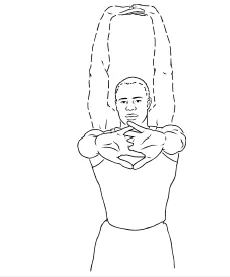
Biceps Stretch
You can stretch your biceps in several ways. Your range of motion can be enhanced by stretching your biceps. The standing bicep stretch is typical. Additionally, it can help with shoulder and chest stretching.
- Take a high stance and ease your shoulders down your spine.
- With your hands facing down, put your arms behind you.
- Lock your fingers together.
- Raise your arms behind you as high as you can comfortably while maintaining a straight posture.
- Repeat this stretch up to three times, holding it for up to one minute before letting go.
Shoulder Flexion
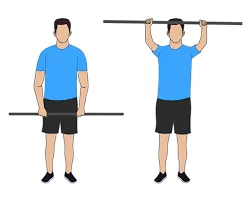
Your vertical range of motion is enhanced by shoulder flexion. Perform 10 repetitions of this exercise multiple times during the day. Stop and consult your physical therapist for adjustments if you experience pain. They might change the workout or move you to an alternative shoulder flexion exercise.
- Start with your palms toward your thighs and both arms by your sides.
- With your palm facing away from you and your fingers pointed at the ceiling, raise your arm.
- Gently return your arm to your side after holding it aloft for five seconds.
Elbow Flexion
Your affected side’s range of motion can be improved by elbow flexion.
- Let both arms drop to your sides.
- Bring your palm up to your shoulder while flexing your elbow.
- Your physical therapist might advise you to increase the flexion by bringing your palm closer to your shoulder with your unaffected hand.
- Next, relax the arm at your side and lower your palm.
Shoulder Internal Rotation
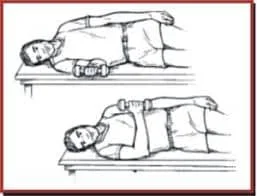
Both biceps and the shoulder joint rotation are required for shoulder rotation. It enables you to keep your shoulder joint in its full range of motion.
- Bend your knees while lying on your back.
- Make a right angle with a weight in the hand on the injured side.
- With the weight raised in your hand, place your elbow against your side and make contact with the surface you are resting on.
- Move the weight away from your body, palm up, while keeping your elbow against your side and in contact with the surface.
- Avoid fully lowering your hand.
- Return the weight and hand to its starting right angle.
Shoulder External Rotation
Exercises for shoulder external rotation can help reduce pain and increase or maintain shoulder mobility. One example of an external rotation stretch for the shoulder is as follows.
- In your house, select a doorway.
- As you stand in front of the door frame, make a straight angle with your forearm and upper arm while holding the door frame with your hand on the injured side.
- Hold your elbow against your body on the affected side with the hand on the unaffected side.
- You should turn your body away from the doorframe.
- When your shoulder starts to stretch out, stop and hold it for five seconds, or as directed by your physical therapist.
To perform this exercise properly, avoid bending your back and maintain your arms as still as you can.
Forearm Twist
Twists in the forearm improve arm flexibility.
- Start with your arms by your sides.
- Make a 90-degree bend in your elbow.
- Hold for five seconds after turning your palms upward.
- For five seconds, turn your palms downward.
- Bring your arms back to your sides.
- For five seconds, hold this exercise.
Shoulder Circle Crossover
When you have biceps tendonitis, this exercise helps with shoulder mobility.
- Start with your arms at your sides and a straight posture.
- With the palms facing forward, extend your arms to the side.
- Move your arms behind you while bringing your shoulder blades together.
- With your hands facing ahead, lift your arms.
- The hands should come together.
- Cross your arms in front of your body until they are horizontal at this point.
- Next, turn the motion around so that your palms are facing away from you and behind you.
- Do one or two sets of this exercise three to six times, or as directed by your physical therapist.
Bicep Curls
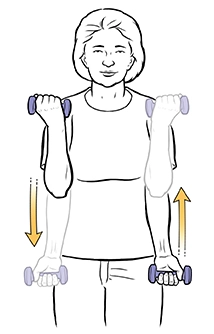
You may safely lift objects by strengthening your upper arm muscles with biceps curls. Because it requires concentric strengthening, this exercise might be avoided earlier in the rehabilitation process. Before using it, talk to your physical therapist about it.
Choose weights that will be difficult by the time you reach ten, but still allow you to keep proper form. Instead of depending on momentum to push you through your repetitions, pay attention to form.
Stop and ask your physical therapist for advice if you are in pain or find it difficult to maintain proper posture.
- Maintain a hip-width distance between your legs while using your core.
- With your hands facing front, hold one dumbbell in each hand.
- With your palms facing you, bend your elbows and move the weights toward your shoulders while keeping them against the side of your body.
- The weights should then be lowered to their starting position.
Prevention
Prevention is the best course of action because tendinitis is mostly caused by overuse. Avoiding or altering the activities that lead to the issue is important. While engaging in physical activity:
- Start out softly and increase your level of activity over time.
- Limit both the number of repetitions and the force you apply.
- If you experience sudden pain, stop.
- When playing sports or working, take care to avoid and then fix bad posture or technique.
Summary
You can have biceps tendonitis if you experience pain in the front of your shoulder. It may be challenging to use your arm for everyday tasks and outdoor activities due to this condition. You can improve your strength and range of motion, reduce pain, and regain your previous level of function and activity by working with a physical therapist to perform a variety of exercises.
FAQ’s
A deep, throbbing pain in the anterior shoulder is a common complaint from patients with biceps tendinitis. Usually confined to the bicipital groove, the pain may spread radially down to the hand or toward the deltoid muscle’s insertion.
The Speed’s test, Yergason’s test, and uppercut test are special tests for bicipital tendinitis that involve particular movements intended to simulate pain in the bicipital groove when a therapist applies resistance. Another crucial component of the evaluation is the direct palpation of the bicipital groove.
Biceps tendonitis (often called biceps tendinitis) is the most prevalent condition affecting the biceps. Rotator cuff tears are a common misdiagnosis for this illness.
References:
- Bicep tendonitis. (2025, June 2). Cleveland Clinic. https://my.clevelandclinic.org/health/diseases/bicep-tendonitis
- Ames, H. (2021, April 29). What to know about bicep tendonitis. https://www.medicalnewstoday.com/articles/bicep-tendonitis
- Rd, R. a. M. (2022, September 29). Biceps tendinitis: What is it and what to do about it. Healthline. https://www.healthline.com/health/sports-injuries/bicep-tendonitis#takeaway
- Pt, B. S. (2025, May 11). 8 Bicep tendonitis exercises. Verywell Health. https://www.verywellhealth.com/biceps-tendonitis-rehab-4771784