V-Ups Exercise
V-Ups Exercise is a powerful core workout that targets your abdominal muscles, hip flexors, and lower back. In this move, you lift your upper and lower body simultaneously to form a “V” shape, engaging your entire core for strength and stability. It’s excellent for improving balance, coordination, and overall core definition.
Are you seeking an enjoyable exercise challenge? The finest workout for burning and developing your abdominal muscles is the V-up or jackknife. V-ups, often known as V sit-ups, are bodyweight core exercises that work several body parts at once.
As you sit on the ground with your torso off, your balance improves. Now, all you need to do is get a yoga mat and try this exercise at home. But are you wondering how to perform V-ups efficiently without any specific equipment at all?
Table of Contents
What Is V-Ups Exercise?
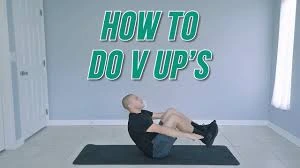
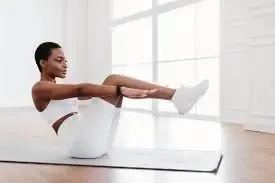
The V-sit ab workout challenges your balance while simultaneously strengthening several parts of your core. This workout involves sitting with your torso off the ground and your legs outstretched, producing a V shape with your body.
If you’re starting off, you can adjust it so that you need a little help from your hands or bend your legs. The V-sit can be added to core and abdominal exercises by intermediate athletes.
Muscles Used While Performing V-Ups Exercise
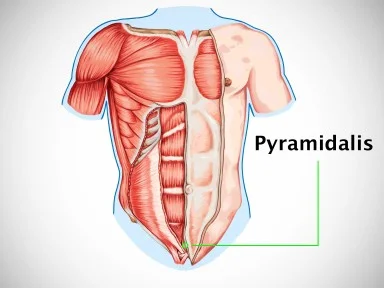
- The rectus abdominis, which extends from just below the ribs to the pelvis, is the main muscle used in V-ups. Its main purpose is to compress the torso to bring the chest closer to the hips. Additionally, the rectus abdominis stabilizes the torso and helps the hip flexors raise our legs during workouts like V-ups.
- V-ups also use other midsection muscles, such as the transverse abdominis and obliques, mostly to maintain our stability. In a similar vein, torso stiffness is affected by the back musculature.
- During V-ups, the quadriceps, hamstrings, and glutes stabilize and raise our legs off the ground. The arms are moved to the ceiling and behind the body by the muscles in our upper back and shoulders (deltoids).
V-Ups Exercise Video
How To Perform V-Ups Exercise?
Start sitting with your feet and hands on the ground.
- Lift your legs to an extended position at a 45-degree angle with your body while slowly contracting your core and abdominal muscles.
- Stretch your arms as far forward as you can or as high as you can to your shins. Throughout the exercise, it’s essential to keep a strong spine and proper core posture, and to prevent rounding your shoulders. Breathe deeply during the exercise; don’t hold your breath.
- To start, maintain this V-shaped position for a few seconds. Hold the pose for longer as you gain strength.
- Maintaining tight, engaged abs, slowly return to your starting position.
- Just before you reach the ground, hold the pose for a few seconds.
- Repeat the entire movement multiple times.
Variation in Performing V-Ups Exercise
- Bent-Knee V-Up
- Alternating Leg V-Up
- V-Up Hold
Bent-Knee V-Up
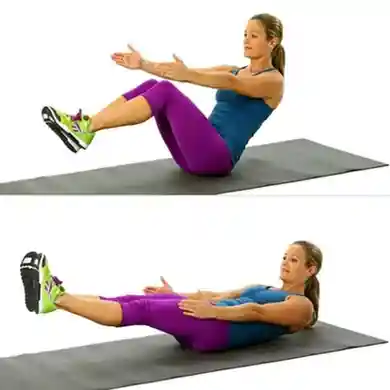
An easier alternative with many advantages is the bent-knee V-up. In contrast to standard V-ups, the goal is to elevate your torso and legs while maintaining a bent knee. This makes the exercise easier to teach to beginners by requiring less core strength and stability.
Alternating Leg V-Up
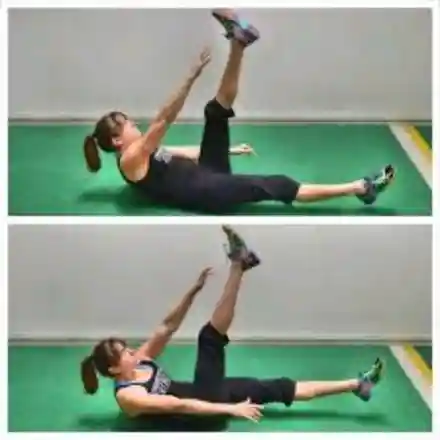
Another variant is the alternating leg V-up, in which you raise one leg at a time. For instance, you raise your left leg to the ceiling while raising your torso. After that, you go back to your starting posture, crunch once again, and raise your right leg.
V-Up Hold
Another beginner-friendly exercise that increases whole-body stability and isometric strength is the V-up hold. Position yourself in the starting position, raise your torso and legs to the ceiling, and brace your core. Hold the top position for five to thirty seconds, then let go.
Benefits of Performing V-Ups Exercise
Because it works the internal and external obliques as well as the hip flexors, the V-up exercise is a great way to strengthen the trunk and core balance. Other benefits of performing V-ups include:
- In order to keep proper posture, it improves balance, coordination, and core strength.
- Preventing falls and improving performance in other physical activities are two advantages of V-ups for the body.
- With the legs arranged in a V, this stance is comparable to the boat pose. The arms are raised in the air, but that is the only extra feature. It may be quite simple for those who are skilled in Pilates and yoga.
Common Mistakes To Avoid While Performing V-Ups Exercise
- Rounding Back and Shoulders
- Swinging the Arms
Rounding Back and Shoulders
- Rounding the shoulders and back at the peak of the exercise is one of the most frequent errors committed when performing the V-sit. The legs and back form a V at the top of a proper V-sit ab workout. The workout is less effective when you bend your back forward since it draws attention away from your core and hurts your lower back, leaving your abs with less control.
- V-sits are made easier by doing this, but it may be more harmful to your back. Rather, keep your back, neck, and head in a straight line from your lower back. Throughout the exercise, your entire body should remain straight from the starting posture.
Swinging the Arms
- Swinging your arms up when lifting your legs and back is another error made during the V-sit. The V-sit’s impact on the core muscles decreases when the arms are moved. Rather, begin in the starting posture with your arms at your sides.
- Your arms should remain at your sides and parallel to the ground while you rise. When lifting, keep your arms parallel to the floor rather than pointing your fingertips to your toes.
Precautions
- If you have back or neck problems, consult your doctor or physical therapist about whether the V-sit is appropriate. This ab exercise can stress the neck and compress the spine if done incorrectly. Your core muscles should be working and possibly burning, but if you experience severe pain, stop.
- After the first trimester of pregnancy, when the belly starts to swell, avoid V-sits.
Summary
- V-ups, or V sit-ups, are effective bodyweight core exercises designed to strengthen abdominal muscles and improve balance. This exercise involves sitting with the torso off the ground, forming a V shape with legs extended. The primary muscle targeted is the rectus abdominis, along with supporting muscles like the transverse abdominis, obliques, quadriceps, hamstrings, and glutes. To perform V-ups, engage your core while lifting your legs and arms simultaneously, maintaining proper posture throughout.
- Variations include the Bent-Knee V-Up, which is easier for beginners, the Alternating Leg V-Up for added challenge, and the V-Up Hold for improving stability. Benefits of V-ups encompass enhanced core strength, better balance, and improved posture. Common mistakes to avoid include rounding the back and shoulders or swinging the arms, which reduce the exercise’s effectiveness. Precautions should be taken for individuals with back or neck issues, and the exercise is not recommended after the first trimester of pregnancy.
FAQ’s
V sit-ups challenge the core muscles by asking the performer to recline on the floor, then elevate the legs and torso off the ground to form a V with their body. V-sits are a difficult exercise that is a good step up from standard sit-ups.
This is because v-ups are more effective at working all of your abdominal muscles, including your obliques and lower abs. Standard situps, on the other hand, will train your abs, but they tend to have more of a focus on your upper abs
Start with four sets of five to eight repetitions. Aim for four sets of nine to nineteen repetitions for intermediate-level athletes. Aim for four sets of 20 or more repetitions if you’re an advanced athlete. For optimal results, perform these V-ups three times a week.
References:
- Ms E. Q. (2024, August 16). How to Do a V-Sit. Verywell Fit. https://www.verywellfit.com/v-sit-ab-exercise-3120059
- Stefanov, P. (2025, May 29). V Up: How-to, tips, variations, mistakes & Alternatives. Hevy – #1 Workout Tracker & Planner Gym Log App. https://www.hevyapp.com/exercises/how-to-v-up/
- Fit, C. (2022, July 26). How To Do V-Ups Exercises: Benefits, Techniques, Variations & More. blog.cult.fit. https://blog.cult.fit/articles/how-to-do-v-ups-exercises-benefits-technique-and-more