
How to Do Flutter Kicks Correctly?
Flutter Kicks are a core-strengthening exercise that primarily targets the lower abdominal muscles, hip flexors, and legs. They involve lying on your back and performing a rapid, alternating up-and-down leg motion, which helps improve core stability, endurance, and overall lower body strength.
You may target many muscles in your lower back and abdomen with this workout without the need for additional equipment—all you need is you. The majority of individuals can perform flutter kicks, so adding them to your normal workout routine is a smart idea.
Although you might know a little bit about flutter kicks, it’s normal to be curious about the right technique and the precise regions they target.
Table of Contents
What Are Flutter Kicks
- A bodyweight cardio workout is the flutter kick. To perform flutter kicks, elevate your legs slightly off the ground while lying on your back. Lift one leg and lower the other for a few repetitions while strengthening your core muscles.
- Flutter kicks target your lower abdominal muscles more than other core exercises like crunches and sit-ups, while also activating your hip flexor, lower-back, and quadriceps muscles.
- When performed correctly, flutter kicks can raise your heart rate and improve cardiovascular health. While there is no equipment needed for the traditional flutter kick, you could want to add some weight to your ankles to make the exercise more challenging.
- Lift your upper body throughout the exercise such that it creates a V shape with your lower body for a more complex variation.
Muscles Used In Flutter Kick
- During the exercise, the rectus abdominis is the main muscle that is used. In addition to covering the stomach, our rectus abdominis reduces the gap between the pelvis and ribs. In addition, the muscle group acts to maintain our legs in the air and flexes isometrically to support our torso.
- Additionally, kicks work all five hip flexors. The group of muscles helps the abs maintain our legs up and move them up and down.
- The quadriceps, hamstrings, and glutes also do a certain amount of work. Despite their minimal participation, these muscles are crucial for many leg actions and support during a workout.
How To Perform Flutter Kicks
Start by doing 2-3 sets of 10-20 repetitions on each side for flutter kicks. Based on your capacity to keep up correct form during each set and repetition, choose your sets and repetitions.
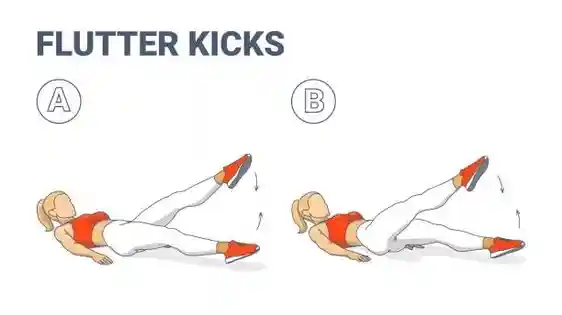
- Lie face up with your legs straight on an exercise mat to begin. Either position your hands behind your glutes or your arms at your sides, palms down. For the entire duration of the activity, keep your chin tucked in, as though you were holding an egg beneath your chin.
- Your ribs should be down, and your pelvis partially tucked in. Point your toes away from your body and raise your legs 4–6 inches off the ground while using your core. This is where all repetition should start.
- Lift one leg a little higher than the other while lowering the other leg, all the while maintaining your balance. Until the required number of repetitions has been achieved, keep moving your legs in a controlled, alternating pattern.
- Bring your legs together and return them to the floor in a controlled manner while keeping your alignment.
Variation in Performing Flutter Kicks
- Prone Flutter Kick
- Criss-Cross Flutter Kick
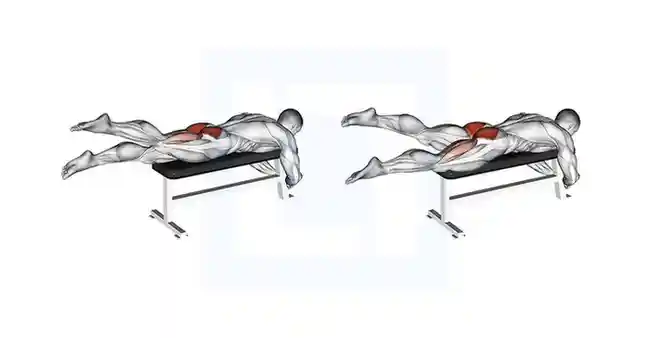
Prone Flutter Kick
- Lie down on your stomach and support yourself with your arms under your chin or outstretched overhead.
- Raise both legs a little off the ground by using your glutes and core.
- Start kicking with your legs straight and in short, alternating up-and-down motions.
- Don’t overarch your lower back and keep your breathing regular.
- Go on for the number of repetitions or the appropriate duration (e.g., 20–40 seconds).
Criss-Cross Flutter Kick
- With your hands supporting your glutes, lie flat on your back.
- Raise both legs, your head, and your shoulders a few inches off the floor.
- Start by crisscrossing (scissoring) one leg over the other while maintaining a straight posture.
- Maintain a constant rhythm of alternating while using your core.
- Perform for a certain number of repetitions or 20–40 seconds.

How to Do Flutter Kicks Correctly?
Benefits of Performing Flutter Kick
- Strengthening Your Core
- Improving Muscle Balance And Stability
- Enhancing Muscular Endurance
- Supporting Lower Back
- Boosting Calorie Burning
Strengthening Your Core:
- Multiple core muscle areas are targeted with flutter kicks.
- This exercise strengthens your upper abs, flexors, and lower abs, one of the most difficult areas to work on.
- You can perform other exercises more easily and lift more weights if your core is stronger.
Improving Muscle Balance And Stability:
- This exercise helps you develop overall stability and balance by strengthening your muscles.
- You may do daily activities more simply with the help of Flutter Kicks.
Enhancing Muscular Endurance:
- Flutter kicks help your body become more flexible, strong, and powerful.
- You can increase your total flexibility and stamina due to muscle endurance.
- You may also train your body to tolerate heavy physical activity in life or in sports.
Supporting Lower Back:
- This exercise helps to build your lower body muscles since it works your hip flexors and lower back.
- This eliminates the need for additional strain when engaging in everyday activities like walking, running, and even standing.
- This exercise helps you avoid future health risks, including sciatica and lower back pain, in addition to improving your posture.
Boosting Calorie Burning:
- Because flutter kicks require a lot of movement, they are used in both bodyweight ab exercises and aerobic conditioning.
- This indicates that you are burning calories, which results in fat and weight reduction, in addition to strengthening your abs.
Common Mistakes To Avoid While Performing Flutter Kicks
- Arching Your Back
- Not Engaging Your Abs
- Keeping Tension in Your Neck
- Losing Your Form Over Time
- Going For Too Long
Arching Your Back:
- You should ideally have your lower back pushed against the floor. He suggested imagining your butt tucked in or your belly button pushed against your spine.
- Your pelvis will shift toward a more neutral position if you consider tucking your butt.” Pull down your ribs and tuck your butt. Your back is leaning on the floor, and your spine is losing its curvature.
- Try sliding your hand under your lower back to get a quick sense of whether you’re arching your back. He advised that if you can move your hand all the way across your back, you could be putting yourself at risk for harm. “Try pressing your lower back into the ground so that your hand cannot slide under it.”
Not Engaging Your Abs:
- In order to get the most out of flutter kicks and lower your chance of injury, it’s essential that you contract your abs.
- “Your back is tense if your abdominal muscles aren’t working.” That isn’t the purpose of the exercise and might get your back weaker or cause spasms.”
Keeping Tension in Your Neck:
- You should keep your spine “neutral” when performing flutter kicks. This means that you shouldn’t have an arched neck. “Be sure you’re not straining yourself.”
- You should keep your head on the ground.
Losing Your Form Over Time:
It’s easy to lose form over time, and flutter kicks may be difficult. “Your back lifting or your abs feeling less active are indicators that your abs are tired and need a rest.”
Going For Too Long:
Flutter kicks can technically be performed for as long as you can keep proper form, but sets of 30 to 60 seconds are actually hardly required. “Doing flutter kicks for several minutes won’t help,
Precautions While Performing Flutter Kicks
- Before starting an exercise program, consult with your doctor if you have a history of health issues.
- For a workout program to be safe and successful, proper technique is essential, but depending on your demands, you might need to adjust each exercise to achieve the best results.
- Whenever choosing a weight, be sure it gives you complete control over your body during the exercise. During any workout, be mindful of your body and stop right away if you experience any pain or discomfort.
- Incorporate appropriate warm-ups, rest, and nutrition into your workout routine to see ongoing development and build muscle.
- Your capacity to sufficiently recover from your exercises will ultimately determine your outcomes. Before working out the same muscle groups, take a day or two off to allow for adequate healing.
Summary
- They are ideal for strengthening your core and increasing your general level of fitness. We’ve discussed the muscles used, how to do them, and several variations in this article.
- All you have to remember is to maintain a neutral back and a braced core. Include this exercise in your routine to achieve the tight abs you’ve always wanted. However, keep in mind that exercise alone cannot develop abs.
- Building six-pack abs also requires you to adopt healthy practices in your everyday life.
FAQ’s
When you do a correct flutter kick, your legs must move in coordination, starting from your hips and finishing with your toes pointed. What you wish to do is written down as follows: Motion Driven by the Hips: Your hips, not your knees, should be the starting point for the kick. This indicates that the kick movement uses your full leg.
As long as you can maintain proper form, you can technically perform flutter kicks for as long as you like, although those sets of 30 to 60 seconds are actually unnecessary.
You may vary the frequency at which you flutter your legs; a quicker pace could lead to a workout that is more cardio-oriented. If you’ve never done flutter kicks before, start off at a slower speed and concentrate on keeping your form correct and engaging your core.
The bodyweight aerobic workout known as “flutter kicks” works many core muscle groups. Flutter kicks are an excellent workout for strengthening your core and flattening your tummy, but if you only focus on one area, they mostly target your lower abs.
References:
- Stefanov, P. (2025, May 29). Flutter Kicks: how-to, tips, variations, mistakes & more. Hevy – #1 Workout Tracker & Planner Gym Log App. https://www.hevyapp.com/exercises/flutter-kicks/
- How to do flutter kicks: form, muscles worked & techniques. (n.d.). SQUATWOLF. https://squatwolf.com/blogs/fitness/how-to-do-flutter-kicks-correctly
- Flutter kicks: What are they and what muscles do they use? (n.d.-b). Nike.com. https://www.nike.com/jp/en/a/what-are-flutter-kicks