Pyramidalis muscle
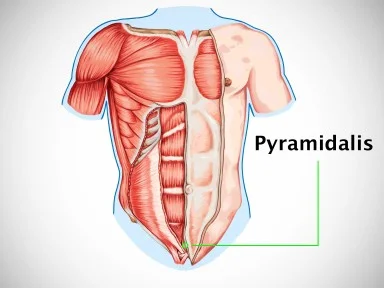
Pyramidalis muscle is a small triangular muscle, anterior to the rectus abdominis muscle, and contained in the rectus sheath.
Origin:
pubic symphysis and pubic crest.
Insertion:
linea alba.
Nerve supply:
Subcostal nerve (T12).
Actions:
tensing the linea alba.
When performed alone, the tensing of the linea alba by the pyramidalis muscle serves no important purpose. Pyramidalis muscle does, however, work in combination with the other abdominal muscles to support a number of abdominal wall tasks, such as raising intra abdominal pressure when necessary such as during labor, forced expiration, or feces.
Variations and Absence:
The pyramidalis muscle exhibits significant anatomical variations. It may be absent in some individuals, and its size, shape, and attachment points can vary.
Relations
The pyramidalis muscle has several anatomical relations with other structures in the abdominal region. Here are some important relationships:
Rectus Abdominis Muscle: The pyramidalis muscle lies deep to the rectus abdominis muscle, which is a long, paired muscle that runs vertically along the anterior abdominal wall. The pyramidalis muscle is located in the midline, just medial to the rectus abdominis muscles.
Linea Alba: The pyramidalis muscle inserts into the linea alba, which is a fibrous structure in the midline of the abdomen. The linea alba is formed by the fusion of the aponeuroses (tendon-like structures) of the abdominal muscles, including the rectus abdominis muscles. The pyramidalis muscle contributes to the support and tension of the linea alba.
Pubic Bone: The pyramidalis muscle originates from the pubic crest, which is a bony ridge on the front of the pubic bone. The base of the pyramidalis muscle is attached to this bony prominence.
Bladder and Uterus: In females, the pyramidalis muscle lies anterior to the urinary bladder and uterus. It is situated deep to the superficial fascia and subcutaneous fat layers.
Anterior Abdominal Wall Structures: The pyramidalis muscle is situated deep to the skin, subcutaneous fat, and the superficial fascia of the anterior abdominal wall. It is surrounded by other muscles, including the external oblique, internal oblique, and transversus abdominis muscles.
Clinical Significance:
The pyramidalis muscle is rarely a source of clinical concern. However, in certain surgical procedures like abdominal incisions or flap reconstructions, it may be intentionally dissected or removed to gain access to deeper structures.
It’s important to note that while the pyramidalis muscle exists, it is not considered a critical muscle for normal abdominal function, and its absence or variation does not typically cause any functional deficits or impairments.
Vestigal Muscle
A vestigal muscle is the pyramidalis muscle. The term “vestigial muscles” refers to muscles in humans that are mostly tendinous, smaller than analogous muscles in other species, or frequently absent within or between populations.
Pyramidalis shares a phylogenetic relationship with pouches found within monotremes like hedgehogs and platypuses as well as marsupials like koalas and kangaroos.
FAQs
Within the rectus sheath, the pyramidalis is a little triangular muscle that is anterior to the bottom portion of the rectus abdominis muscle. It is joined to the anterior and superior edge of the pubis by tendinous fibers and to the pubic symphysis by ligamentous fibers.
In 20% of persons, the pyramidalis muscle is missing. On either one or both sides, this muscle may not exist. The bottom end of the rectus then grows in size correspondingly. Sometimes it is double on one side, and there might be differences in size between the muscles on the two sides.
A Simple Exercise to Maintain a Strong Pyramidalis Muscle
Take a seat in comfort.
With your fingers pointing toward your abdomen and your thumbs pointing toward your spine, place your hands at the base of your ribs.
As you inhale deeply through your nose, pay attention to how your rib cage expands.
The linea alba is tensed by the pyramidalis muscle. The muscle typically contracts with the other muscles of the abdomen, helping to tighten the wall of the abdomen and raising the positive abdominal pressure.
The pubic symphysis and pubic crest are connected to the pyramidalis muscle, which has its origin in the bony pelvis. At a location halfway between the pubis and the umbilicus, the fibers pass superiorly and medially before inserting into the linea alba.