
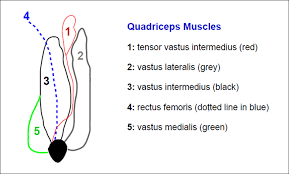
Tensor vastus intermedius muscle: 5th quadriceps muscle
Tensor vastus intermedius is a muscle in the anterior compartment of thigh. It located between the vastus intermedius and the vastus lateralis. The structure has been previously reported but has not been described nor illustrated in any textbook.
The muscle name tensor vastus intermedius was given by Grob et al. in 2016.
This muscle is the Fifth muscle of The Quadriceps muscle other four muscle are Rectus Femoris, Vastus Lateralis, Vastus Medialis and Vastus Intermedialis.
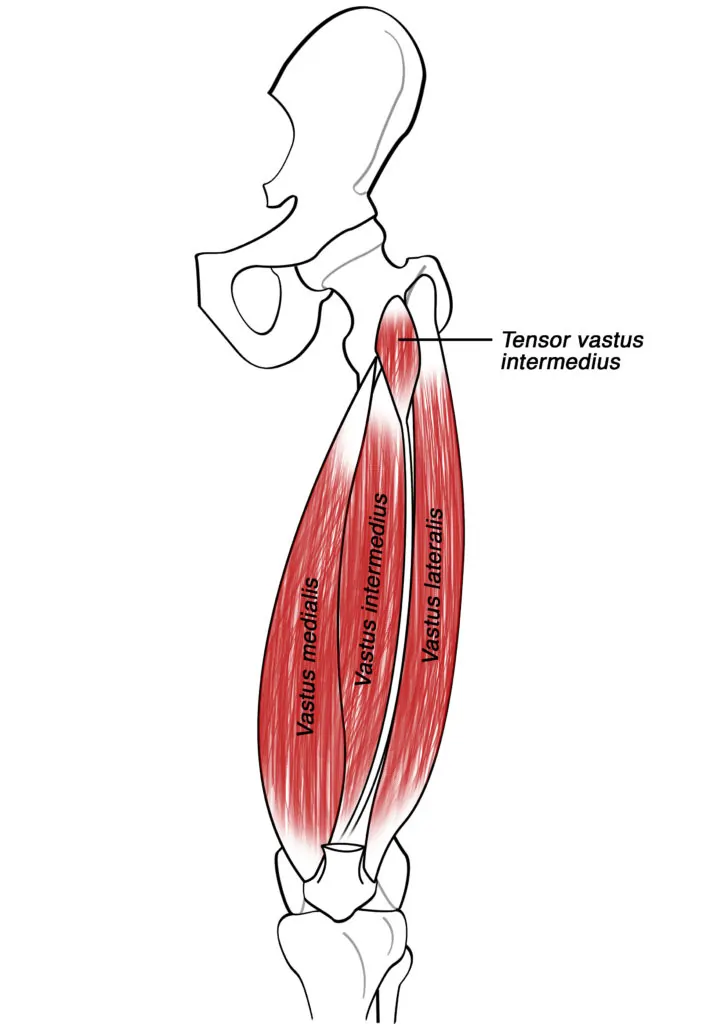
Table of Contents
Origin:
The tensor vastus intermedius muscle originates from the proximal part of femur specifically from the anterior part of the greater trochanter.
The muscle lies anterior to the vastus intermedius but deep to the rectus femoris. The tendinous part of the muscle is closely related to, and sometimes fuses with, the aponeurosis of the vastus intermedius.
Insertion:
It joins the quadriceps tendon and inserts to the medial aspect of the patella.
Nerve Supply:
Femoral nerve.
Blood Supply :
The lateral circumflex femoral artery.
Action :
The muscle tenses on the aponeurosis of the Vastus intermedius and also medialises the action of the muscle. It also acts as a second tensor in addition to the TFL (tensor fasciae latae).
Extension of the Knee.
Variations of Tensor vastus intermedius muscle :
The tensor vastus intermedius is found in the anterior compartment of the thigh and has a similar morphology to the other vasti muscles. It has five main variations and a consistent neurovascular supply.
- The independent type
- VI-type
- VL-type
- common type
- two-belly type.
- The independent type of the muscle are the most frequent type, has its tendon located between the vastus intermedius and the vastus lateralis.
- The VI-type and the VL-type – the tendinous part of the muscle is integrated into the fascia of the vastus intermedius and the vastus lateralis respectively.
- The common type, it has a non-separable origin between the intertrochanteric line and greater trochanter.
- Two Belly Type – separate muscle bellies can be found for the two-belly types.
How were the studies of the tensor vastus intermedius done ?
In 2016, Grob et al.21 discovered a new muscle in the quadriceps group. The researchers dissected the quadriceps of 26 cadavers and he found a new muscle, the tensor vastus intermedius.
This discovery needs more studies with the objective to detect the localization of the muscle in other cadavers and the researchers need to detect muscle activation of this muscle with EMG to know in which joint movement it is present.
In another study that occurred in 2016, Grob et al.27 dissected the quadriceps of 7 cadavers (5 men – 2 women) and the researchers detected the new muscle, the tensor vastus intermedius.
Therefore, this study confirmed the new muscle of the quadriceps.Then, this muscle need to be called another name because it has five muscles. But researchers need to study with EMG for they determine the action of this muscle.
The third research article from the same group on the new muscle was practiced in 2016. Grob et al.28 studied the quadriceps of a slightly obese female of 62 years old (n=1). They found with MRI(magnetic resonance imaging) showing a rupture of the aponeurotic tendon of the new muscle of the quadriceps, the tensor vastus intermedius. This injury impaired knee action. Therefore, tensor vastus intermedius has knee action.
The last research article on the new muscle is from Indian researchers from another research laboratory. Veeramani & Gnanasekaran 29 studied the quadriceps of 36 cadavers of the Indian. The researchers detected a length of the muscle is 145.40±37.55 millimeters (mm). Female tensor vastus intermedius had a length of 162.59±47.41mm (n=9) and the male was of 139.70±32.72mm (n=27).
Conclusion :
The tensor vastus intermedius is an important muscle for the knee extension.
This is very important for the physical trainer prescribes the strength training for the tensor vastus intermedius.


I don’t know before reading this nice article about tensor vastus intermedius muscle, this 5th muscle of Quadriceps is an important muscle for knee extension.